Building an integrated internal audit: how it works
An integrated internal audit bundles processes and evidence. How to plan criteria, the audit team, samples and the follow-up of corrective actions.

Philipp Kappe
Founder of IMScollect
Contents
- What an integrated internal audit brings together
- 1. Separate the audit programme from the individual audit plan
- 2. Combine the three perspectives in one process
- 3. Define criteria, evidence and coverage in advance
- 4. Put together the audit team to suit the audit assignment
- 5. Document findings from within the process
- 6. Track implementation and effectiveness separately
- Conclusion
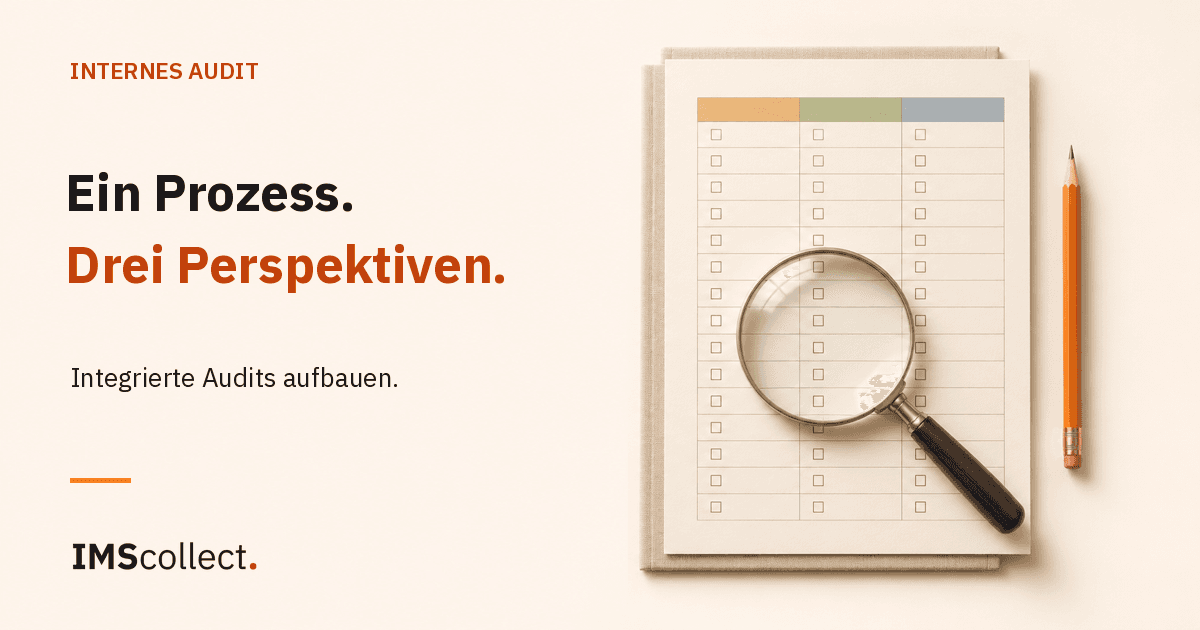
Three management systems quickly lead to three audit plans, similar interviews and evidence requested several times over. An integrated internal audit instead starts from a real process and looks at it from several subject-specific perspectives. This article shows a practical set-up: a shared programme, clearly delimited criteria, suitable samples and traceable follow-up.
What an integrated internal audit brings together
Integration does not mean working through three questionnaires one after another at the same appointment. Shared process steps, contacts and evidence are bundled where it makes sense. The evaluation, by contrast, remains tied to the applicable requirements: a supplier that has been properly approved has not automatically been adequately assessed with regard to its environmental performance or its handling of confidential data.
The following set-up is an organisational aid, not a complete checklist of the standards. Binding audit criteria are determined by the editions of the standards, internal rules and relevant obligations that apply in your own management system. The publicly available guidance of the ISO 9001 Auditing Practices Group on internal audits supports a risk-based and process-based approach. It is explanatory guidance, not an additional normative requirement.
1. Separate the audit programme from the individual audit plan
The audit programme describes which processes and areas are audited over a chosen period, with what priority and with what resources. It takes into account the importance of the processes, changes, relevant risks and previous results. The audit plan, by contrast, specifies a single audit: objective, scope, criteria, people involved, schedule and planned samples.
Start with an overview of the processes and their subject-specific points of contact. The existing process map is better suited to this than three isolated lists of clauses. Also check which sites, shifts and outsourced activities need to be considered. Not every one of these units has to appear in the same audit; coverage across the programme must, however, be traceable.
A new high-risk service provider, repeated complaints or changed environmental conditions may call for different priorities than an unchanged, stable process. A rigid “everything once a year” pattern is therefore not a sufficient justification for your own planning. Frequency, depth and methods should suit the specific situation.
2. Combine the three perspectives in one process
A process with clear interfaces, such as procurement, is a good pilot. Follow a specific case from the description of the need through selection and contract award to performance evaluation. Add the following example questions only where they are actually relevant.
| Process step | Quality | Environment | Information security |
|---|---|---|---|
| Describe the need | Are performance and acceptance criteria unambiguous? | Have relevant environmental requirements for the material or service been considered? | Which data, systems or access rights are affected? |
| Select the supplier | What evidence of suitability and performance is available? | Which environmental criteria are justified for this purchase? | Has the supplier's risk been appropriately considered? |
| Accept the service | Who checks the agreed service and documents deviations? | Are agreed environment-related conditions checked? | Are the access rights set up and the agreed protective measures traceable? |
| Handle changes | How are effects on quality and deadlines assessed? | Do environmental aspects or relevant obligations change? | Do new data flows or security risks arise? |
The table is a starting point, not a substitute for the criteria matrix. In that matrix, each question used is linked to the specific requirement and its source. For information security, for example, risk treatment and the controls selected for the company are relevant. Environmental questions depend on the actual environmental aspects and obligations, not on whether a question generally sounds sustainable.
3. Define criteria, evidence and coverage in advance
A compact working structure can consist of six fields: process step, audit objective, applicable requirement, audit question, planned evidence and subject-specific assignment. The exact design is up to you. What matters is that it is later possible to see what was actually audited and what was merely mentioned.
A supplier contract can serve several checks. The fact that it exists, however, does not yet prove that quality requirements, environmental conditions and information security agreements are each adequately covered. Therefore document the specific statement of the evidence and the related evaluation.
Define samples with a rationale, for example a new supplier, a case with a complaint and a recently changed service. This selection is an example, not a prescribed sample size. An audit works with limited evidence; an unremarkable individual case does not support a comprehensive statement of conformity for the entire process.
4. Put together the audit team to suit the audit assignment
A shared audit does not require a single person to master all subject areas equally. Plan suitable leadership and the necessary subject-matter competence. Depending on the scope, several auditors or additional technical experts may be useful.
Objectivity and impartiality must be ensured in the selection of auditors and the conduct of the audit. Anyone who is responsible for the audited process should not be the only one to evaluate their own work. In small companies in particular, possible conflicts of interest should be examined openly and limited through a suitable division of tasks or external support. A training certificate alone does not answer whether the team is sufficiently competent for a specific process.
5. Document findings from within the process
Conduct interviews along the actual process and compare statements with documents, records and observations. A finding needs a traceable link between criterion, observed facts and evidence. “Supplier evaluation poor” is too vague for this.
A fictitious example: for a selected service provider, the documented approval before contract award required by internal rules is missing. Record which internal requirement applies, which case was audited and which evidence is missing. Add further subject-specific references only if they are supported by evidence. A missing approval does not automatically mean a nonconformity in every management system.
A shared report can bundle results and still contain separate subject-specific conclusions. Make sure that the responsible management can see both the overall picture and relevant gaps for each audit area.
6. Track implementation and effectiveness separately
After a nonconformity, the first step is to clarify what must be corrected immediately. Then the causes are examined and appropriate corrective actions are defined. Responsibilities, deadlines and expected results must be unambiguous.
An updated form proves a change, not yet its effect. Check, for example, in later procurement cases whether the required approval is now actually in place. The scope and timing of this check depend on the risk and the action. Include remaining gaps and relevant insights in further audit planning and in the management review.
Conclusion
An integrated internal audit needs a shared organisational framework and evaluations that are unambiguous in subject-matter terms. Start with a suitable process, check coverage and extend the approach based on the experience gained. Shared evidence may be used several times; the respective conclusion must nevertheless be justified.
IMScollect supports audit programmes, audits with separate standard areas, the documentation of findings and reporting. Corrective actions are tracked separately. In a demo with your own audit process, you can check how this set-up fits your organisation.
Frequently asked questions
What is an integrated internal audit?▾
A shared audit process looks at one process from several management system perspectives. Interviews and evidence can be bundled; the criteria and evaluations remain clearly assigned to their subject area.
What is the difference between an audit programme and an audit plan?▾
The programme manages several audits over a defined period, including priorities and resources. The audit plan describes the objective, scope, criteria and conduct of a single audit.
Does a single auditor have to cover all subject areas?▾
No. The team must be suitable for the specific audit assignment; where necessary, several auditors or technical experts are used. Objectivity and impartiality must be ensured in the process.
Is one shared checklist enough for three standards?▾
A shared working document can help, but it replaces neither the complete assignment of criteria nor well-founded samples. Shared evidence must be evaluated on its subject-matter merits for every statement derived from it.