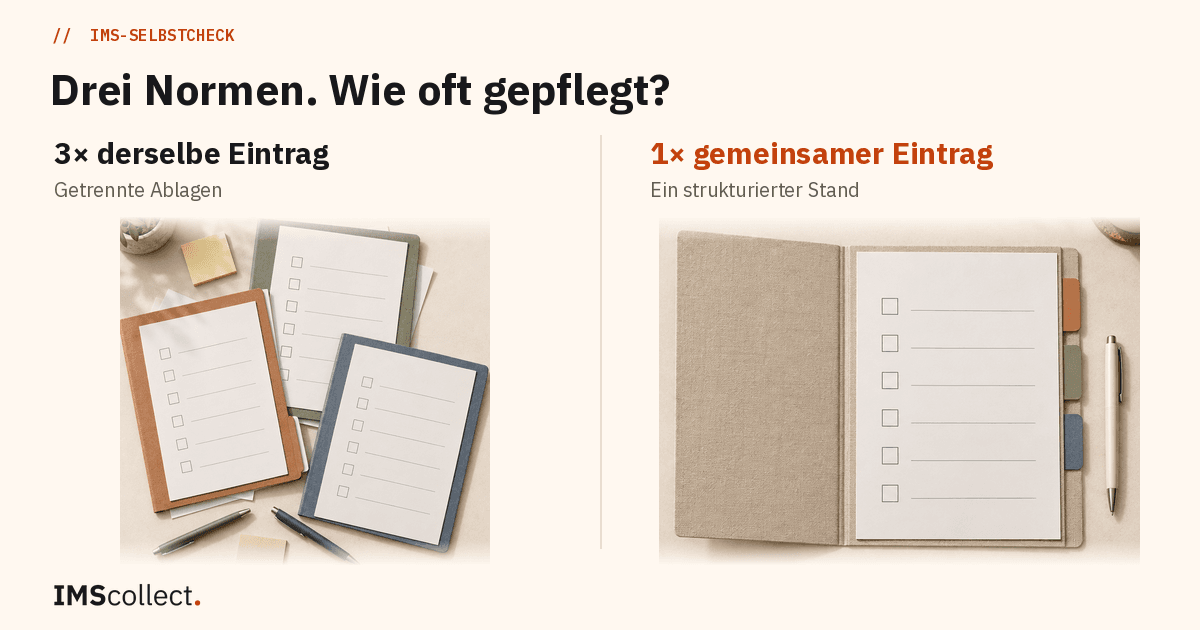
How integrated is your management system really?
Six questions show where your management system works together and where duplicate maintenance arises. A free self-check with concrete next steps.

Philipp Kappe
Founder of IMScollect
Contents
- How to use the self-check
- 1. Is shared master data maintained only once?
- 2. Are those involved working on the same version of the process?
- 3. Does a shared action remain one shared case?
- 4. Can suitable evidence be found without parallel repositories?
- 5. Are changes checked for consequences in other areas?
- 6. Are shared decisions followed through to their effect?
- What the answers mean for the next step
- Conclusion
A shared manual and three certificates do not yet tell you how well day-to-day work fits together. This self-check for an integrated management system therefore does not examine clauses of the standards but six typical interfaces: data, processes, actions, evidence, changes and decisions. Take a real case from your organisation and trace where information is used jointly and where unnecessary duplicate work arises.
How to use the self-check
Choose a case that touches several management areas, for example bringing in a new service provider. Quality management is interested in its performance, environmental management in the environmental impacts of its activities and information security in possible access to information that needs protection. Not every case affects all areas equally.
Answer the questions together with the responsible people involved. For each question, note a specific example or where it can be found. A positive answer without a verifiable case remains an assumption for now. The answer options appear directly below each question; they are for your own assessment, not for calculating a score.
This editorial self-check by IMScollect is a guide for orientation. It is not an ISO questionnaire, not an audit and not a confirmation of conformity with the standards or of readiness for certification.
The basic idea is consistent with established professional thinking: ISO describes integration as connecting several management system standards with the organisation's existing processes. Commonalities should become usable without losing area-specific requirements. The following questions are independently worded practical questions, not taken from an ISO assessment model.
1. Is shared master data maintained only once?
Test question: If a supplier's name, contact person or responsibility changes, does the information have to be corrected by hand in several lists?
Your assessment: Maintained once · Partly shared · Maintained several times · Unclear
Check the same organisation or the same supplier in the repositories you use. Is there a reliable source record and are responsibilities clear? Subject-specific evaluations may remain separate. The quality evaluation does not have to use the same criteria as the assessment of information security risks. Shared master data does not mean a shared answer to every subject-specific question.
2. Are those involved working on the same version of the process?
Test question: Can quality, environment and information security access the same valid process description and see which additional rules apply to their area?
Your assessment: Shared process version · Partly shared · Separate versions · Unclear
Have someone show you the process for commissioning the chosen service provider. If several descriptions exist, clarify whether they are deliberately different processes or merely differently maintained versions of the same process. A process overview with interfaces and responsibilities helps make this difference visible.
3. Does a shared action remain one shared case?
Test question: Is a cross-area action tracked once with responsible people, deadline and progress, or do copies with different processing states arise?
Your assessment: One shared case · Partly shared · Several copies · Unclear
Take an action that is actually open. Check its origin and its references. An agreed change of supplier can affect several areas; the individual subject-specific checks nevertheless remain traceable. If an additional action is needed for one area, that is not an integration failure. What matters is that the separation is justified and the dependency is visible.
4. Can suitable evidence be found without parallel repositories?
Test question: Can authorised people find the valid evidence on the case without first having to search several folders or personal mailboxes?
Your assessment: Linked and findable · Partly findable · Scattered or duplicated · Unclear
Check, for example, where the approval of the service provider is documented. Version, responsibility and the link to the relevant evaluation should be recognisable. A document can support several questions, but does not automatically answer all of them. Likewise, evidence remains protected from unauthorised people, even if the organisation uses shared software.
5. Are changes checked for consequences in other areas?
Test question: Does a relevant change to the process or service provider trigger a traceable review of the management areas affected?
Your assessment: Consequences reviewed jointly · Partly reviewed · Only in own area · Unclear
Trace the last significant change: who was involved and which consequences were assessed? Not every adjustment requires a meeting of everyone involved. What makes sense is a justified decision about which areas are affected. A new processing location can raise different questions than a mere change of contact person.
6. Are shared decisions followed through to their effect?
Test question: Can those responsible trace what was decided and implemented and how its effect is being checked, without first having to reconcile separate status reports?
Your assessment: Traceable as a whole · Partly traceable · Separate reports · Unclear
Choose a completed decision. Are the trigger, decision, responsible people, implementation and later assessment connected? A tick for “done” does not yet prove effectiveness. For joint management, the subject-specific results of the individual areas must remain recognisable; an overall view must not hide them.
What the answers mean for the next step
Do not add up any points. The questions are neither equally weighted nor a validated maturity test. An unclear responsibility may be more important in your case than an address maintained twice.
- Shared and proven by the example: Record what works and who maintains this way of working.
- Partly shared or separate: Check whether the separation is necessary in subject-matter terms or merely creates additional maintenance.
- Unclear: First make the actual process visible. Lack of clarity is not automatically a breach of the standard, but it is a good starting point for a joint review.
Then choose one specific improvement. Document today's effort or errors, the person responsible and the expected result. Test the changed process on the next suitable case. Only then can you judge whether integration helps in everyday work.
Conclusion
An integrated management system shows itself in how well people can reuse information and decisions across area boundaries. It requires neither identical processes everywhere nor a blanket overall rating.
If the answers mainly reveal duplicate maintenance and scattered evidence, it is worth looking at what makes good integrated management software. In IMScollect, shared information, actions and references to the standards can be brought together; Conni helps, depending on permissions, with reading the current status and with verifiable suggestions. A demo based on the case you have chosen is the right next step to check whether it suits your own way of working.
Frequently asked questions
How do I recognise a truly integrated management system?▾
Trace a cross-area case: shared information should be reliably maintained, subject-specific evaluations should be distinguishable and actions should be linked to responsible people and evidence. A shared repository or several certificates alone do not answer these questions.
Does the self-check show whether we are ISO compliant?▾
No. The six editorial practical questions help to identify interfaces and duplicate work; they do not replace a review against the applicable requirements of the standards, an audit or certification.
Do all processes have to be identical for an integrated management system?▾
No. Differences that are necessary in subject-matter terms should be retained. The appropriate data and processes are managed jointly; separate evaluations and evidence remain traceable.
Does an integrated management system necessarily need shared software?▾
Integration is first and foremost a question of organisation and collaboration. Shared software can support maintenance and linking, but replaces neither responsibilities nor processes that are actually lived.